What do I actually know?
Name the message, request, action, or absence without adding a motive. If someone asked for distance, that request is part of what you know.
A place for the unresolved
I explore estrangement, accountability, love, and self-government—how to live truthfully and keep another person’s humanity in view when you cannot choose for them.
The book behind the channel
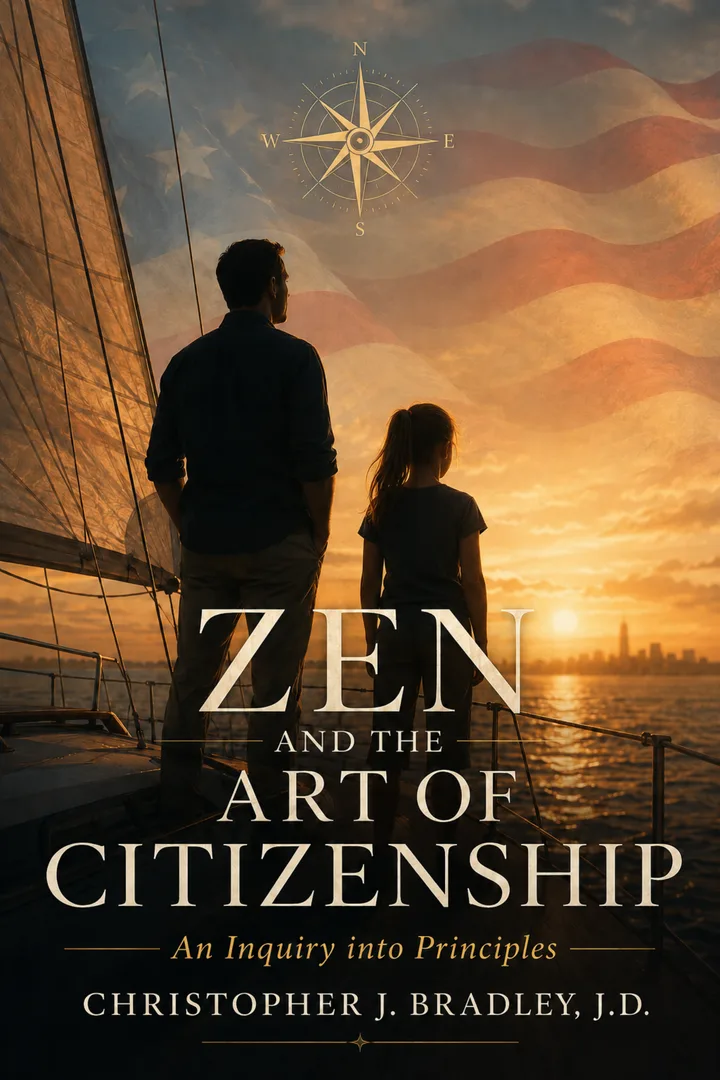
The family is the first republic. This memoir and manual follows one life, from a Pennsylvania kitchen table to the Gulf War, the courtroom, and a sailboat, and tests twenty-five principles of self-government against it.
Start here
When contact is limited or absent, the mind tries to finish the story. These questions separate an event from an interpretation and bring attention back to the conduct that is actually yours.
Name the message, request, action, or absence without adding a motive. If someone asked for distance, that request is part of what you know.
Notice the story you are adding: forever, hatred, punishment, manipulation, or a hidden invitation. A strong feeling is real; it may still be an interpretation.
Choose conduct that does not require another person to respond before it can count: honesty, respect for a boundary, specific accountability, support, or a promise kept today.
A private reflection
Your answers stay on this page in your browser. They are not submitted or saved by this site. You can clear them at any time.
The framework
The family is the first place most of us encounter power, duty, freedom, forgiveness, and repair. These principles hold family’s importance alongside every person’s dignity and agency.
Take the history seriously without claiming complete access to another person’s mind.
Acknowledge specific conduct without turning one action into a verdict on your whole life.
Care deeply without using guilt, money, other relatives, or your suffering as leverage.
Contact, trust, and access can change. Distance may be necessary. Humanity does not become disposable.
Self-government does not mean commanding pain to disappear or performing perfect calm.
Work, friendship, laughter, and purpose can coexist with unresolved loss.
From the channel
The channel begins with adult-child estrangement, especially the questions parents carry in silence. It examines multiple perspectives, avoids diagnosing absent people, and applies principles of liberty and self-government to the relationships closest to us.
A quiet note when something is ready
Open the printable Three Questions reflection now, and get a brief email when a new video and companion page are published. No daily sequence. No family story required.

The greatest lesson
“Life is simple: love everyone, and start with you.”
For most of the last decade, I lived on a sailboat along the northwest Gulf Coast of Florida and photographed more than 2,000 sunsets from the same sacred space. Those evenings taught me to disengage from conflict, dwell in empathy, and ask a simple question:
What if you are the person we are all waiting on?
Love does not require agreement, trust, access, or the abandonment of boundaries. It asks us to refuse to surrender another person’s humanity—or our own.
Explore Love Everyone →About Christopher
I served in the Gulf War in 1991. Combat shaped my understanding of peace and the value of every human life.
Nearly a decade aboard a sailboat and more than 2,000 sunsets became a long education in attention, simplicity, and love.
After years of disrupted family relationships and family-court conflict, I became an advocate for veterans, fathers, and families navigating systems that can deepen division.
My work teaches principles of liberty, responsibility, equal dignity, and self-government to families and communities.
Projects
These projects explore the same underlying questions at different scales: how people govern themselves, live together, protect dignity, and choose what they stand for.
A guided experience for finding peace in one difficult relationship without abandoning truth or boundaries.
Visit →Teaching American founding principles through stories, reflection, and practical learning.
Visit →Civic education focused on constitutional principles, families, and self-government.
Visit →A 28-book children’s series introducing rights, responsibility, and American principles.
Visit →Tools and reflections for deliberate time, growth, healing, and becoming.
Visit →More than 2,000 sunset photographs with reflections on life, love, and attention.
Visit →Resources for strengthening family relationships and preserving family memories.
Visit →Line-by-line review of itemized legal bills for testable errors and questionable billing patterns.
Visit →The book, with a free chapter. A memoir and manual on the principles of self-government.
Visit →Shared postcard marketing for Emerald Coast businesses, one category at a time.
Visit →Books
From constitutional analysis to children’s adventures, the books share a commitment to love, freedom, truth, and personal responsibility. See the complete shelf →
The memoir and manual
An Inquiry into Principles. A Gulf War veteran and lawyer tests the principles of self-government against his own life. Trade and Academic editions.
Read a free chapter and choose an edition →For families and advocates
Family Is Fundamental & Constitutionally Protected explores family rights and constitutional protections.
View on Amazon →For young readers
Stories about courage, truth, fundamental rights, friendship, and finding a peaceful course.
Explore a title →